The conversation
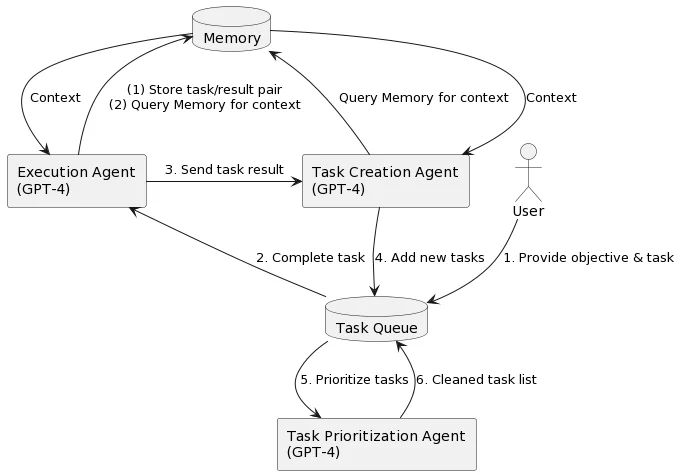
Yohei Nakajima published BabyAGI on GitHub in March 2023, describing the underlying idea two days earlier in a 28 March 2023 blog post as a 'task-driven autonomous agent' built from three GPT-4 calls: one executes the top task from a priority queue, one generates new tasks from that result, and one reprioritizes the remaining queue. The project's own preserved README, now kept in the babyagi_archive repository after later versions of babyagi moved on to a different design, calls it 'an example of an AI-powered task management system' and 'a pared-down version of the original Task-Driven Autonomous Agent.'
What the documents show
The archived README names the same three roles as separate agents: an execution agent that uses the OpenAI API to complete a task, a task-creation agent that generates new tasks from a completed result, and a prioritization agent that reorders the queue, storing task results in a vector database such as Chroma or Weaviate. The blog post is explicit that this is a minimal illustration rather than a finished product, and the archived README warns that 'running this script continuously can result in high API usage,' asking users to run it responsibly rather than presenting it as cost-bounded by design.
The system boundary
Nothing in either document describes an external check on the loop: the three GPT-4 calls generate, prioritize and execute tasks in sequence with no stated human approval step between them, and the loop's only documented limits are whatever budget or manual stop a person applying it imposes from outside the script. The author's own scope for the project is a demonstration of the pattern, not a bounded production system with its own safeguards.
Where it fails
The blog post itself lists limitations the author identified at launch: the system's output quality depends entirely on GPT-4's accuracy, so an incorrect or irrelevant task can propagate into later ones; unchecked task generation can outpace what the loop actually completes; and the prioritization agent can misjudge which task matters most, the author writes, potentially neglecting an important one. The author frames these as reasons the pattern needs 'necessary precautions and continuous refinement' before any real deployment, not as solved problems.
- What stops the task-creation agent from generating tasks faster than the execution agent can complete them?
- Is a person reviewing generated tasks before they reach the execution agent, or is the loop fully unattended?
- How is the vector store of past results being kept from silently drifting away from the original goal over many cycles?
The author's own blog post and the project's archived README describe a demonstration explicitly, with its own named risks; treating the three-step loop as more than that goes beyond what either document claims for it.
Sources & reading trail
The author's own description of the three-agent loop and the limitations he identifies for it.
Source published: 28 March 2023 · Retrieved: 16 September 2026
The archived project's own README describing the execution, task-creation and prioritization agents and its cost-usage warning.
Source published: Not established · Retrieved: 16 September 2026
Documentation, rulings and incident records establish the entry; the boundary reading is Chatbot Field Guide editorial analysis. This retrospective draft does not imply the site published on the event date.