The conversation
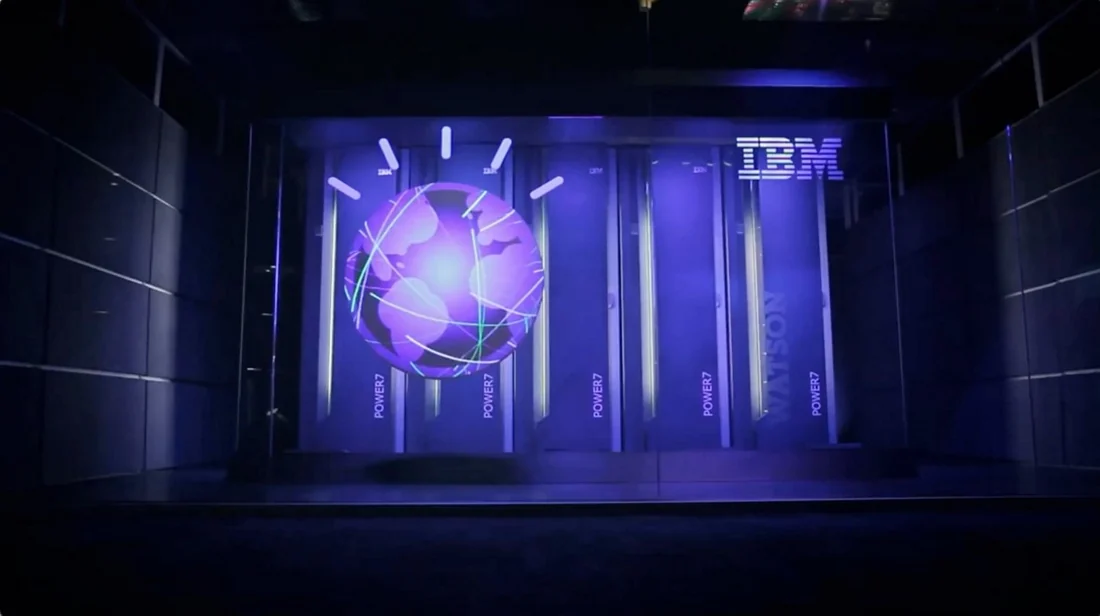
"In a televised Jeopardy! contest viewed by millions in February 2011," IBM's own history page states, "IBM's Watson DeepQA computer made history by defeating the TV quiz show's two foremost all-time champions, Brad Rutter and Ken Jennings." The system was developed by an IBM research team led by David Ferrucci and named after the company's first chief executive, Thomas J. Watson Sr. IBM describes Watson as built to understand clues "posed in natural language and return answers that directly answer the question," competing on the show's own buzzer-and-wager format rather than in open conversation.
What the documents show
IBM's page describes the mechanism in its own terms: Watson would "quickly execute hundreds of algorithms to simultaneously analyze a question from many directions, find and score potential answers, gather additional supporting evidence for each answer, and evaluate everything using natural language processing," and "the more of its algorithms that independently arrived at the same answer, the higher Watson's confidence level," a calculation IBM says the system completed "in about three seconds." The research team's own paper, "Building Watson: An Overview of the DeepQA Project", published in AI Magazine in 2010, describes DeepQA as the product of roughly three years of work by about twenty researchers and reports the finished system reached, in the team's own assessment, "human expert-levels in terms of precision, confidence and speed" on the quiz task — a claim from the system's own developers, not an outside measurement cited here.
The system boundary
IBM's account draws a specific operational boundary: "if the confidence level was high enough, Watson was programmed to buzz in during a game of Jeopardy!. If not, Watson wouldn't buzz." Silence, not a guess or an escalation to a person, was the fallback when Watson's algorithms disagreed. The DeepQA paper frames the whole architecture around that single task, generating and scoring candidate answers to one self-contained clue at a time, rather than around sustaining a multi-turn dialogue or taking actions in a wider environment.
Where it fails
Because DeepQA's pipeline was built for one-shot question answering under a buzzer and wagering format, its win says nothing on its own about open dialogue, multi-step reasoning across a conversation, or the differently branded Watson Assistant conversational products IBM introduced years later; a closed-domain buzzer competition and a general-purpose dialogue agent are different engineering problems, whatever the shared brand name.
- Was the system tested on isolated questions with a defined answer format, or on a sustained back-and-forth exchange?
- Is a confidence-based silence, as Watson's was, an option in the system being evaluated, or is it forced to answer every time?
- Does a later product sharing the same brand name inherit the architecture being described, or only the name?
Watson's Jeopardy! result remains a well-documented benchmark for a specific closed-domain question-answering pipeline, not a general claim about conversational ability that later products can borrow by association.
Sources & reading trail
IBM's own history page states the February 2011 match outcome and describes Watson's algorithm-scoring and confidence-threshold mechanism.
Source published: Not established · Retrieved: 16 September 2026
The IBM research team's own paper describes the DeepQA architecture, its three-year development, and the team's own performance assessment.
Source published: 1 January 2010 · Retrieved: 16 September 2026
Documentation, rulings and incident records establish the entry; the boundary reading is Chatbot Field Guide editorial analysis. This retrospective draft does not imply the site published on the event date.