The conversation
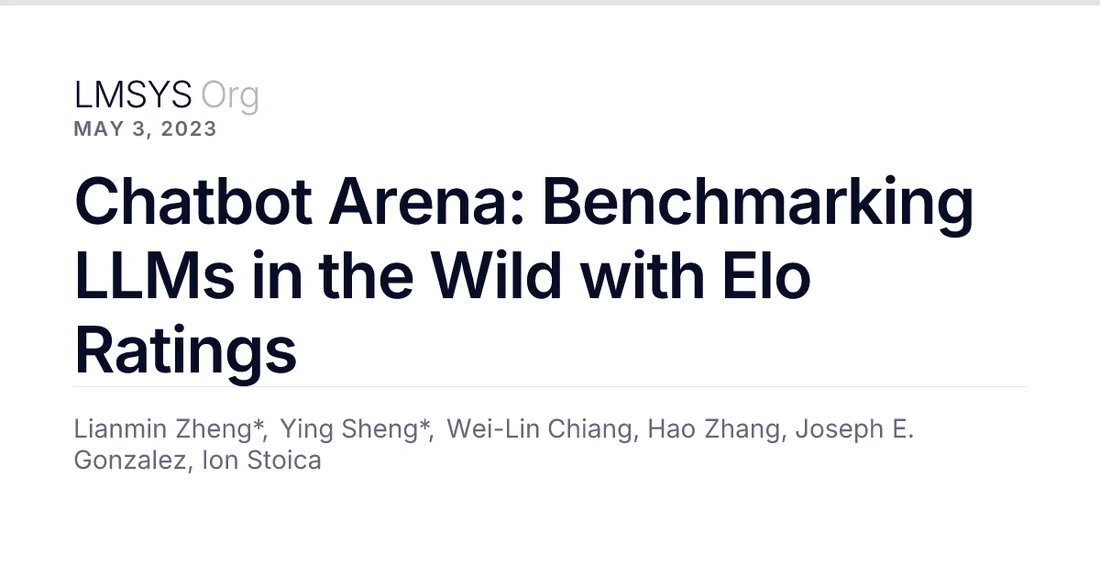
Chatbot Arena is a public benchmarking site run by the research group LMSYS, later organized under the name LMArena, that launched in May 2023. Its own launch announcement describes the format: a visitor can “chat with two anonymous models side-by-side and vote for which one is better,” after which “the model names will be revealed.” A later paper describing the platform, posted to arXiv in March 2024, reports that the project had by then collected “over 240,000 votes” and states the authors' own view that the crowdsourced questions show “sufficient diversity and discriminating power” and reasonable “agreement between crowdsourced and expert raters.”
What the documents show
Both documents describe the same mechanic: identities are hidden during the comparison, and the announcement states that only “votes when the model names are hidden” are used in the platform's analysis, a design meant to stop a voter's opinion of a brand from substituting for a judgment of the specific response shown. The rating is computed with the Elo system borrowed from competitive games, adapted so a model's score moves up or down after each pairwise battle based on the gap between predicted and actual outcome; the announcement reports validating this against “4.7K votes collected over approximately one week.” The arXiv paper adds a robustness claim at far greater scale, once vote volume had grown roughly fiftyfold.
The system boundary
Both documents are explicit about what the ranking measures and does not: an aggregated record of which response a broad, self-selected pool of visitors preferred in open-ended chat, not a graded test of accuracy, safety, or task completion. No mechanism scores a response against a reference answer; the signal is comparative human preference between two outputs to the same prompt. A model can rank well by producing answers people like reading, independent of whether the answer is correct — a distinction the documents draw by design, not disclaimer.
Where it fails
Because the metric is preference rather than correctness, the documented method leaves open how a confident but wrong answer compares to a hedged but correct one; a rater choosing between two responses is not asked to fact-check either. The voting pool is also self-selected — whoever visits the site and chooses to vote — a composition the launch post does not claim is representative of any particular user base. A builder citing an Arena rating as evidence for a model choice should treat it as one input describing conversational appeal, not a substitute for a task-specific evaluation.
- Does the ranking reflect the kind of conversation your deployment actually needs, or a different task entirely, such as code or extraction?
- Who are the voters, and does that population resemble your own users?
- What does a high or low rating say about correctness, as opposed to style, length, or confidence of tone?
As the project's own materials describe it, Chatbot Arena measures aggregated human preference in open-ended chat under anonymized, randomized comparison; both the launch announcement and the paper describing its method frame the platform in exactly those terms, not as a measure of accuracy or safety.
Sources & reading trail
The project's own launch announcement describing anonymous side-by-side voting and the Elo-based rating.
Source published: 3 May 2023 · Retrieved: 16 September 2026
The paper's description of the platform's statistical methodology, its scale (240,000+ votes), and its stated scope as a measure of human preference.
Source published: 7 March 2024 · Retrieved: 16 September 2026
Documentation, rulings and incident records establish the entry; the boundary reading is Chatbot Field Guide editorial analysis. This retrospective draft does not imply the site published on the event date.