The conversation
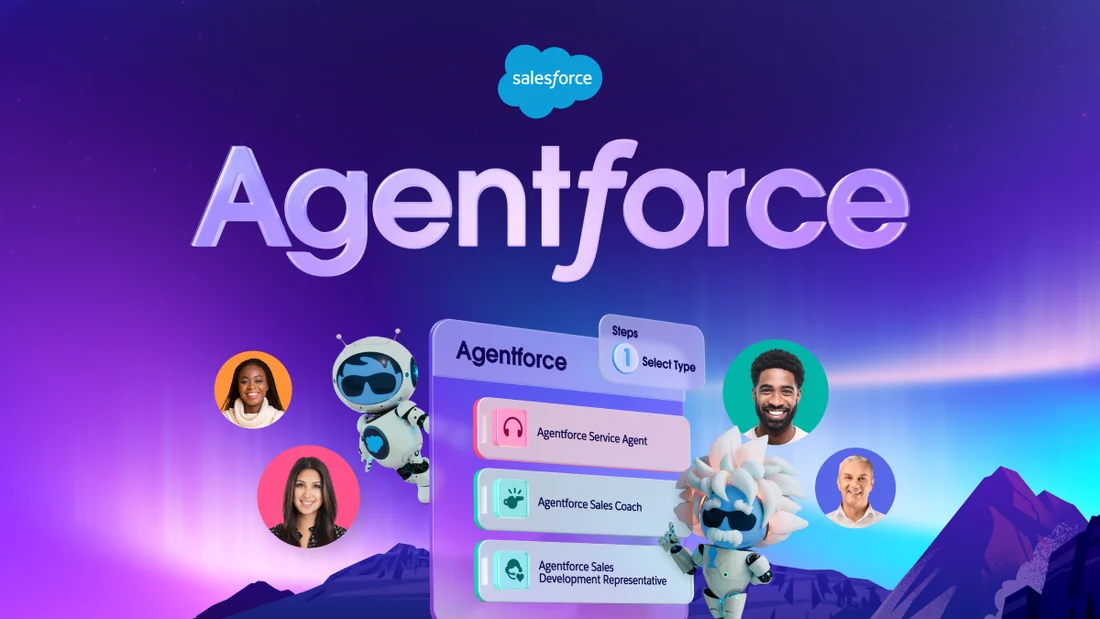
At Dreamforce on 12 September 2024, Salesforce announced Agentforce, describing it in its own press release as a suite of autonomous AI agents for service, sales, marketing and commerce succeeding its earlier Einstein bot products. The release compares the design to a self-driving car: agents use real-time data to adapt to changing conditions while operating inside an organization's own configured limits. Salesforce frames the shift as moving from a generative assistant that drafts text for an employee to a system that can complete a task on a customer's behalf, inside rules the deploying company sets.
What the documents show
Salesforce's Agentforce product page describes Agent Builder as the tool a company uses to configure an agent: it defines topics, writes natural-language instructions for each topic, and assembles a library of actions the agent may choose among. Those actions run through Salesforce Flow, MuleSoft or Apex, so an agent's reach is bounded by whichever automations a company has built and exposed to it. The page also names an Atlas Reasoning Engine that, as Salesforce describes it, breaks an incoming request into smaller steps and proposes a plan before acting. These are the vendor's own descriptions of its own product; they establish what Salesforce says the system is designed to do, not an independent audit of it. Neither document states an adoption or deflection figure, so none is repeated here.
The system boundary
The announcement states that escalation to a person is a designed path: it says that, when desired, the system 'seamlessly hands off to human employees with a summary of the interaction, an overview of the customer's details, and recommendations for what to do next.' The product page adds that when an agent meets a request beyond its configured scope, it is designed to escalate to a human agent. Read together, the documents describe a boundary set by whatever topics, actions and guardrails an implementing company configures, not a fixed line built into the model itself.
Where it fails
Because guardrails, actions and escalation triggers are each configured by the deploying organization, the same platform can be narrow or broad depending on decisions Salesforce's documentation leaves to the customer. Neither cited document specifies how a company verifies that a guardrail actually blocks what it was meant to block, or how a customer discovers that an agent misclassified a request before it reaches an action. A builder evaluating this kind of platform is trusting a configuration layer whose failure modes are not detailed in the vendor's launch materials.
- What happens when an agent's plan calls an action a guardrail should have blocked, and how is that logged for review?
- How is a handoff summary verified for accuracy before a human employee acts on it?
- What record distinguishes an agent's action from a human's when a customer disputes an outcome?
Salesforce's own materials describe configurable scope and a designed human handoff; they do not themselves show how that architecture holds up once an organization has filled in its own topics, actions and guardrails.
Sources & reading trail
Company's own announcement of Agentforce, its self-driving-car framing, guardrails and the human handoff description.
Source published: 12 September 2024 · Retrieved: 16 September 2026
Current product page describing Agent Builder, actions, guardrails, the Atlas Reasoning Engine and human escalation.
Source published: Not established · Retrieved: 16 September 2026
Documentation, rulings and incident records establish the entry; the boundary reading is Chatbot Field Guide editorial analysis. This retrospective draft does not imply the site published on the event date.