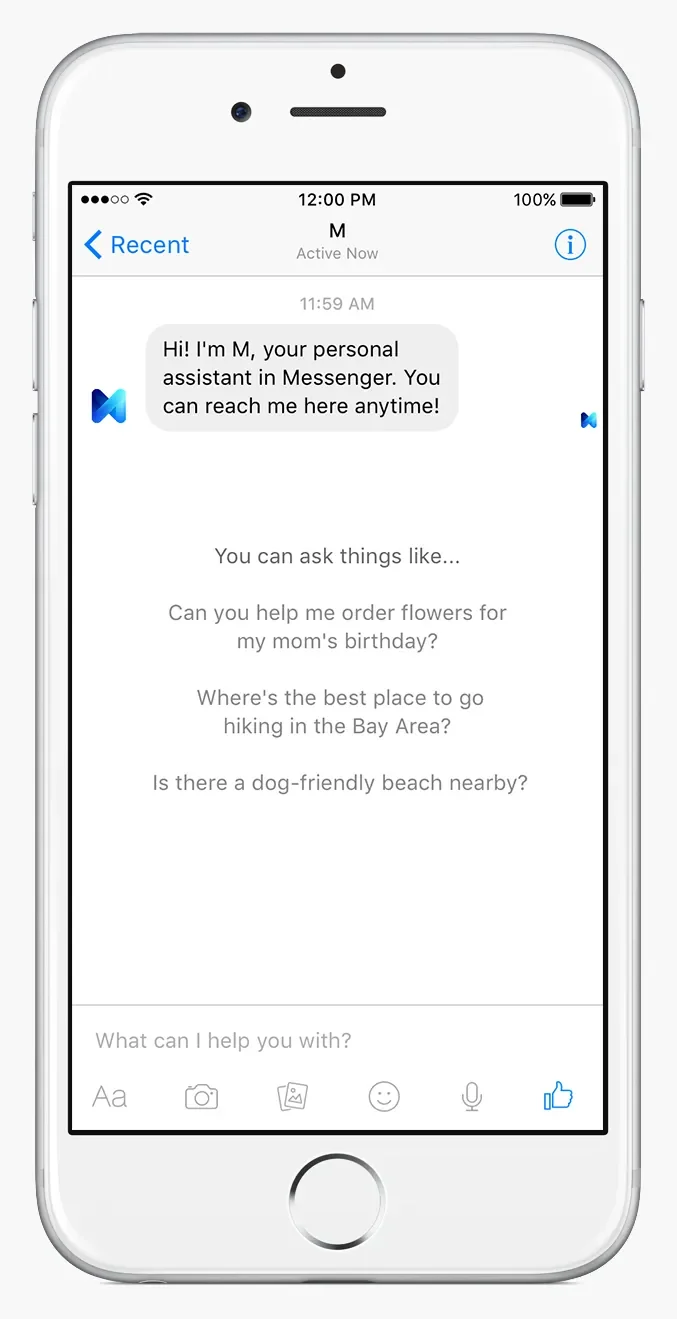
The conversation
On 26 August 2015, Facebook let a small group of Bay Area Messenger users try M, a new assistant that could, per Wired's exclusive report that day, "make restaurant reservations, buy a birthday present for your spouse, or book a weekend getaway." David Marcus, Facebook's vice president of messaging products, told Wired M could "perform tasks that none of the others can" because, "in addition to using artificial intelligence to complete its tasks, M is powered by actual people."
What the documents show
Wired's report, carrying Marcus's own description, states M combined software with Facebook employees and contractors dubbed "M trainers," who had customer service backgrounds and handled requests the software could not, such as negotiating with a cable company on hold. Marcus said the company would not disclose how many trainers it employed but anticipated "thousands" over time. On 8 January 2018, TechCrunch reported that Facebook confirmed, in a statement given to The Verge, it was shutting the standalone M service down effective 19 January 2018. TechCrunch's report states the M brand and some underlying capability persisted through Messenger's AI-powered suggestion features, such as prompts to set a reminder or share a location, rather than disappearing outright.
The system boundary
M's boundary was built into its design from the start, not added after a failure: Wired's report describes trainers sitting near Facebook's engineering team specifically to make "the trickier judgment calls" and complete steps software could not, with Marcus stating "M learns from human behaviors" as the intended path toward more autonomous software over time. Users, per the report, were not told whether a given reply came from software or a person.
Where it fails
The available sources do not state why Facebook ended the human-assisted service, only that it did; TechCrunch's report describes the confirmation and shutdown date without quoting a reason from Facebook. That gap matters for any builder relying on a similar human-in-the-loop design: the staffing of M trainers was, by Marcus's own account, expected to scale into the thousands, and the documented outcome was discontinuation of the standalone product after roughly two and a half years.
- If our product depends on human staff to complete what the software cannot, have we modeled the staffing cost at the user volume we are targeting, not just at pilot scale?
- Do our users know, the way M's did not, whether a given response came from a person or a model?
- When a hybrid product is discontinued, what happens to the underlying technology and the data it collected, as Messenger's suggestion features absorbed pieces of M?
M is a documented early case of a human-in-the-loop consumer assistant reaching a public shutdown, distinct from a pure software failure.
Sources & reading trail
Wired's exclusive report, carrying Facebook VP David Marcus's own description of M as a hybrid of artificial intelligence and human 'M trainers' who complete tasks the software alone cannot.
Source published: 26 August 2015 · Retrieved: 16 September 2026
Reports Facebook's confirmation of M's shutdown effective 19 January 2018 and that Messenger retained AI-powered suggestion features built from the underlying technology.
Source published: 8 January 2018 · Retrieved: 16 September 2026
Documentation, rulings and incident records establish the entry; the boundary reading is Chatbot Field Guide editorial analysis. This retrospective draft does not imply the site published on the event date.