The conversation
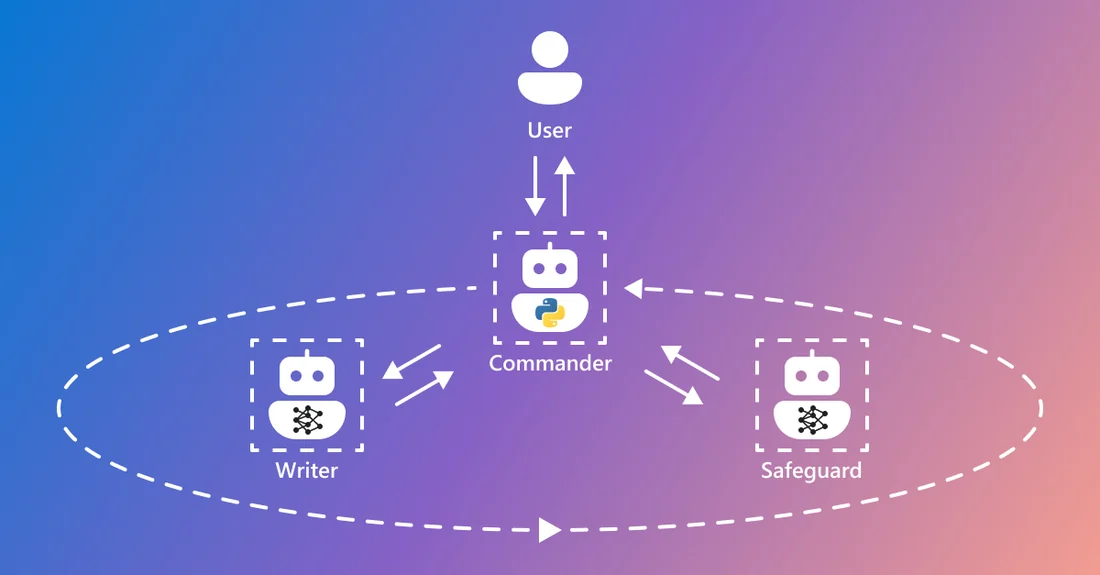
In September 2023, Microsoft Research published a blog post introducing AutoGen, an open-source framework for applications with more than one language-model agent. The post describes AutoGen as a way to simplify "the orchestration, optimization, and automation of LLM workflows" by letting agents built from models, tools, or humans exchange messages until a task is done. The premise: some tasks go better when a model plays several roles in sequence, or when differently instructed models check each other's work before a result reaches a user. Microsoft calls these "conversable agents" that "can converse to solve tasks," citing a coding agent paired with a reviewer, or specialists coordinated through a manager agent.
What the documents show
The announcement describes building a multi-agent system in two steps: "defining a set of agents with specialized capabilities and roles" and "defining the interaction behavior between agents" — what an agent does on receiving another's message. For conversations with more than two participants, the post describes a GroupChatManager agent that repeats a cycle: select a speaker, ask it to respond, broadcast the reply to the group. AutoGen's current documentation, retrieved 16 September 2026, describes ending a conversation differently: a termination condition "returns a ... message if the conversation should be terminated, or None otherwise." It lists built-in conditions, including one that stops after a set number of messages and one that stops on specific text, and states conditions "can be combined using the AND and OR operators." Neither the 2023 announcement nor the current project page states that a conversation, however configured, will reach a correct answer.
The system boundary
AutoGen's own description places the correctness question outside the framework. The library provides the conversational plumbing — who speaks next, what is passed along, when the exchange stops — and the announcement documents that developers can put humans in the loop at "different involvement levels and patterns." What is not automated is judgment about whether the output is right: that is left to whatever termination condition, review agent, or human step a developer configures. The framework does not claim to verify an agent's output against a ground truth; it manages when and how agents talk.
Where it fails
A termination condition ending a conversation is not the same as the conversation producing a good answer: agents can reach a message count, a keyword, or a timeout without ever converging on a workable solution, and the documented combinable conditions, message counts, timeouts, token limits, are process controls, not correctness checks. A team building on AutoGen must add its own verification step if it wants one.
- What termination condition ends this workflow, and does it test the answer or just the conversation's length?
- If a review agent approves another agent's work, what stops both agents from sharing the same blind spot?
- Where in the configured chat does a human actually see the output before it is used?
Read together, Microsoft's announcement and its current documentation describe a coordination layer, not an accuracy guarantee. This is an editorial distinction worth carrying into any multi-agent deployment: the pattern is configurable, and configuration is not verification.
Sources & reading trail
Microsoft's own description of conversable agents, the two-step configuration process, and the GroupChatManager pattern.
Source published: 25 September 2023 · Retrieved: 16 September 2026
Current framing of AutoGen as a framework for building AI agents and applications, retrieved as a living document.
Source published: Not established · Retrieved: 16 September 2026
Current documentation of termination conditions and their combinability, showing configuration rather than a correctness guarantee.
Source published: Not established · Retrieved: 16 September 2026
Documentation, rulings and incident records establish the entry; the boundary reading is Chatbot Field Guide editorial analysis. This retrospective draft does not imply the site published on the event date.