The conversation
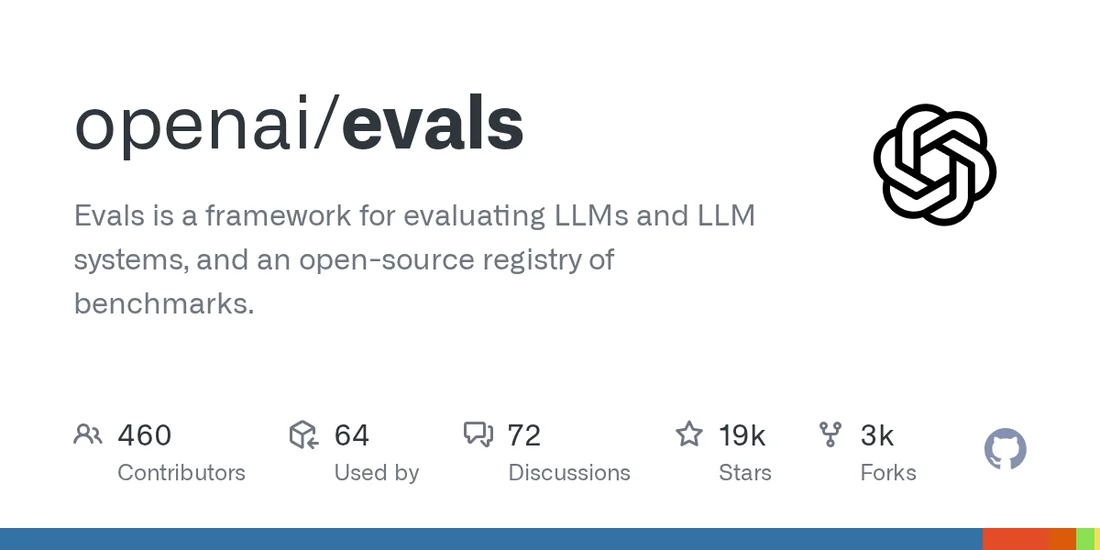
OpenAI open-sourced Evals in March 2023, publishing code it uses internally to check whether a model's answer meets a stated bar. The project's own repository describes itself as a framework for evaluating large language models or LLM-based systems, paired with an open registry of pre-built test suites. A companion guide OpenAI still hosts, Getting Started with OpenAI Evals, frames the idea plainly: an eval is a task measuring a model's output quality, given an input prompt and a way of judging the response against an ideal answer. Neither document describes one launch event; both are maintained references, described here as retrieved on 16 September 2026, well after the 2023 release.
What the documents show
The repository states two ways to grade a completion. The first writes validation logic directly: a string match against an expected phrase, or code checking whether a completion parses as valid JSON. The second is model grading, a two-stage process where a model answers a prompt and a second pass asks a model to judge whether that answer was correct, useful for open-ended tasks such as judging whether a joke is funny. The cookbook page states organisations can fold evals into a continuous-integration pipeline to confirm an accuracy level before deploying a change. The repository is explicit about scope: it does not accept evals requiring custom code, restricting contributions to string-match or model-graded formats defined in YAML.
The system boundary
An eval, on this documentation's own account, only measures what a chosen test set asks it to measure. It runs offline against a fixed dataset of inputs and ideal answers a developer has written in advance; it does not observe a live conversation, and it does not decide whether a model should ship. A model-graded eval substitutes a second model's judgement for a person's, presented as a practical shortcut, not independent verification. A human's role stays fixed in writing the eval: choosing prompts, ideal answers and passing criteria is an editorial act performed before any run, and the framework only reports whether a completion matched what was specified.
Where it fails
Because an eval only tests what its author wrote, a model can score well while still failing a task the eval never posed. The FAQ invites more comparisons across templates rather than treating any one as sufficient alone. A model-graded result also depends on the grading model's own reliability, which the repository does not separately certify. Builders should watch for eval sets that are too narrow, too old for a current model, or graded by a model with its own blind spots.
- Does the eval set include cases that resemble the deployment's actual failure history, not only textbook examples?
- If a model grades another model's answer, has anyone checked the grading model's judgements against a person's?
- Would a new model version need a new eval, or does the existing registry entry still describe the behaviour that matters?
This is an editorial reading of documentation that OpenAI maintains as a living reference rather than a dated announcement: a passed eval is evidence about a specific, named test, not a general safety claim.
Sources & reading trail
OpenAI's own description of the Evals framework, its registry, grading approaches, and its stated exclusion of custom-code evals.
Source published: Not established · Retrieved: 16 September 2026
OpenAI's own definition of an eval as a graded task and its description of code-based versus model-graded evaluation.
Source published: Not established · Retrieved: 16 September 2026
Documentation, rulings and incident records establish the entry; the boundary reading is Chatbot Field Guide editorial analysis. This retrospective draft does not imply the site published on the event date.