
Workflow orchestration / Official workflow-debugger screenshot
The workflow canvas became a debugging record.
Dify announced Workflow as a drag-and-drop, multi-step application type with node-level configuration, testing, and run logs.
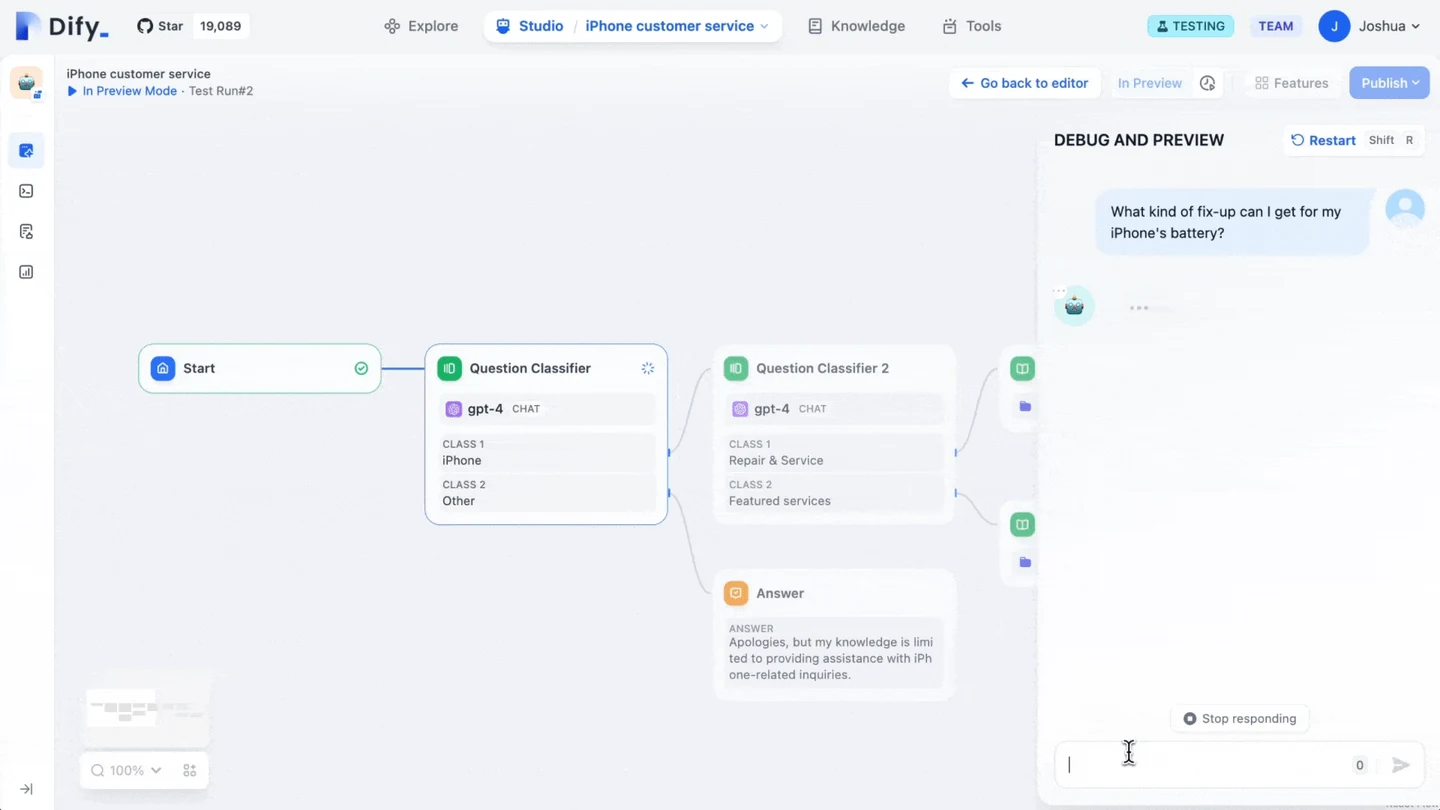
The documented moment
Dify announced Workflow on 8 April 2024 as a drag-and-drop application type for multi-step logic. The release post named LLM, tools, question classifier, knowledge retrieval, code, conditional, template, variable-assignment, and HTTP-request nodes. It also described end-to-end and node-level testing, run logs, and DSL export/import. This is a dated first-party announcement, not a benchmark of reliability or a promise that a workflow automatically makes model output predictable. The workflow image was reopened from the same release page on 19 September 2026; no separate capture date is displayed.
What a builder can borrow
Represent uncertain and deterministic work differently. A classifier should return a label with confidence or a route to clarification; a policy check should return a clear pass, fail, or escalation; a tool call should record its inputs and outcome. Name the data contract at each connection so a later editor can identify whether a failure began in retrieval, transformation, prompting, authorization, or the destination system. Logging the final answer alone hides the useful question: what information and decisions made that answer possible? Keep test fixtures for the failure paths, not only a polished demo input.
A useful prototype test
Run a small suite where retrieval returns nothing, a classifier sees an ambiguous request, an API times out, and a user changes their mind during a pending action. For each run, check that the trace explains the state, that the fallback is safe, and that the customer-facing reply does not pretend completion. These are suggested build checks rather than results from Dify testing. Any exported workflow may still contain secrets, private endpoints, or licensed assets, so review it before sharing.
Keep the evidence attached
Source and limits
Introducing Dify Workflow ↗ · Dify · 2024-04-08. Product status and documentation may have changed since this dated announcement. The design lessons are our editorial synthesis.
Source imagery is included for local owner review only. Copyright remains with the respective rights holders; public reuse is not cleared.