
Embodied systems · Explore this field ↗ · Architecture · 4 min read
Speech-to-face and lip-sync integration: treat timing as a contract
How to connect speech synthesis, facial animation, expression direction, and rendering without letting a character’s face contradict the conversation.
See the source / a related case
Start with one performance clock
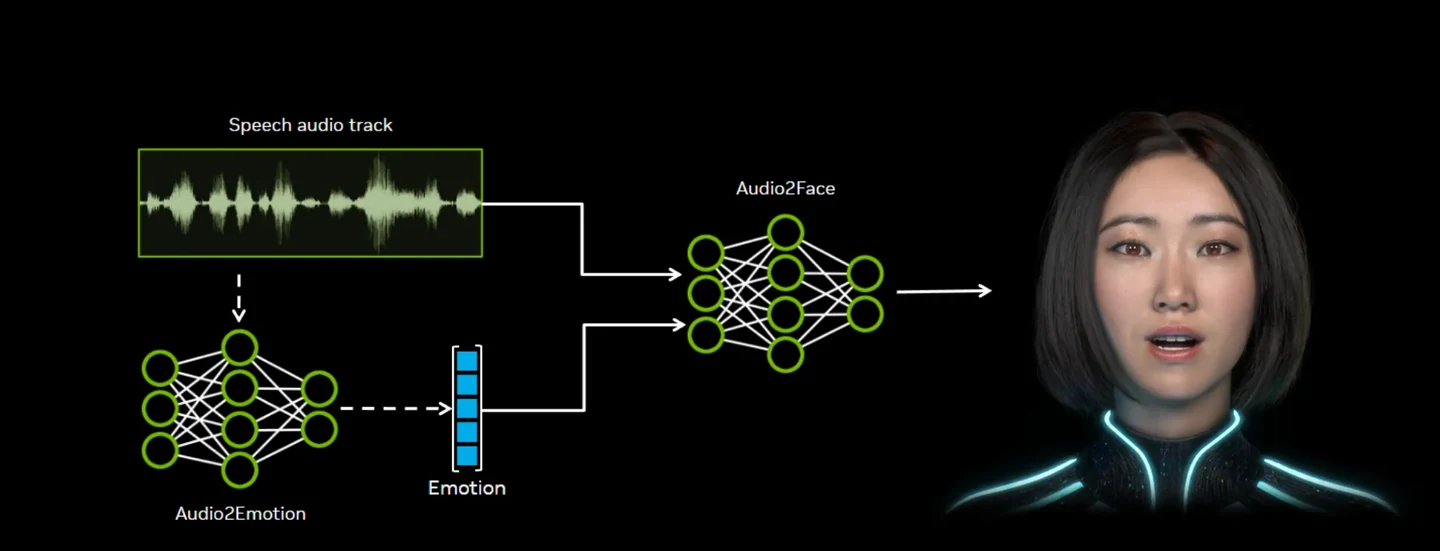
A voice agent usually creates more than one timeline: partial text, generated audio, playback position, face-animation frames, gesture events, and dialogue state. Do not synchronize those streams by assuming they all begin when an API request returns. Assign a performance identifier when audio is committed for playback. Store the audio timebase, start time, duration or chunks, and the facial frames derived for that same identifier. The renderer should schedule those frames against audible playback, not against the text-generation clock. If playback is buffered, delayed, replaced, or stopped, the face controller receives the same lifecycle event. This turns a visible mismatch into a diagnosable clock problem instead of an aesthetic mystery.
Make the facial contract explicit
NVIDIA’s Audio2Face-3D documentation describes output through ARKit blendshapes and supports real-time speech-to-facial animation. That does not guarantee that a particular avatar has the same blendshape names, ranges, neutral pose, symmetry, or artistic meaning. Build a mapping table owned by the character team: incoming channel, avatar target, clamp range, smoothing rule, missing-target behavior and test pose. Keep the table versioned with the avatar. A numerical value should never be treated as a facial expression until it has been viewed on that exact mesh under the intended lighting and camera. If the avatar uses bones, textures, or custom morphs instead, declare the adapter and the loss of detail rather than calling it compatible by implication.
Do not make mouth motion carry emotion
Speech-derived mouth movement answers a narrow question: how should the mouth, jaw and related face channels move with this audio? Dialogue policy answers a different question: what affect, gaze, pose or gesture is appropriate for this turn? Let the behavior planner send a bounded semantic cue such as neutral, attentive, explaining or apologetic, and let the animation layer resolve it through an approved character vocabulary. Blend it with speech motion through declared channel priorities. This prevents a prosody detector, a text label, and a manual animation from all writing to the same facial target without an arbitration rule. It also makes it possible to reduce expressive motion for accessibility or sensitive flows while preserving intelligible speech.
Cancellation must reach every layer
Barge-in is not merely an audio concern. When a user interrupts, stop or fade audio, stop accepting additional face frames for that performance identifier, clear queued visemes, and settle the avatar to a neutral or listening state. Preserve only the dialogue content that the user plausibly heard; do not let an unheard tail decide the next action. The same rule applies when a TTS provider fails, the player is muted, a network reconnects, or the agent changes its answer. A visible cancellation test is more useful than a happy-path demo: interrupt on a plosive, on a long vowel, just before a gesture, and after the audio has started but before all animation frames arrive.
Instrument drift, not just latency
Log enough to reconstruct a performance without retaining unnecessary audio: performance identifier, requested and actual playback start, audio duration, facial-frame sequence range, cancellation time, adapter version and renderer errors. In a staging scene, overlay a simple waveform, mouth target and playback cursor. Watch for accumulated drift across streamed chunks, not only a first-frame delay. Test network jitter, sample-rate conversion, mobile backgrounding and a renderer that drops frames. The goal is not a universal millisecond target. It is a stated tolerance for this character and task, plus a fallback—such as a neutral listening face or text transcript—when the system cannot keep the channels aligned.
Keep claims modest
Speech-to-face services can produce animation controls; that is not evidence that a character is emotionally accurate, trustworthy, or more helpful. A vendor’s supported output topology is a compatibility claim, not a benchmark for your scene. Validate the complete experience with the intended avatar, language, voice, device and interruption behavior before describing it publicly.
Primary reading
Sources and limits
These links support the architecture, policy, or product behavior discussed above. Vendor documentation describes vendor features; it is not independent proof of performance. Current details should be rechecked before a production decision.