What a chatbot actually is
A practical system definition—from the message box to the policies, tools, people, and failure paths behind it.
Read guide ↗ TURNTAKINGREVIEW
The complete library
Search by problem or filter by field. Every guide names the user goal, system behavior, failure mode, operator action, and primary sources.
76 guides
A practical system definition—from the message box to the policies, tools, people, and failure paths behind it.
Read guide ↗Choose the least flexible mechanism that can safely complete the job.
Read guide ↗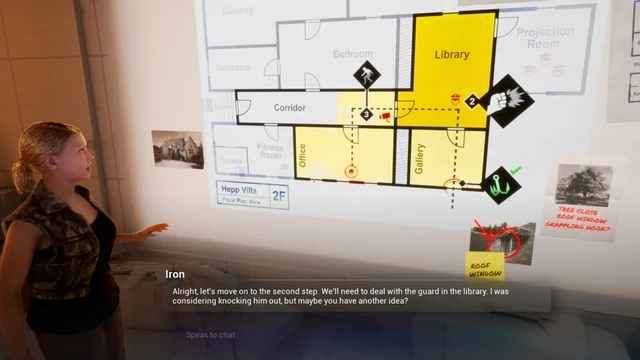 Ubisoft · source visual / reviewFoundations2 min
Design session state, user profile, retrieval context, and long-term memory as separate promises.
Read guide ↗Web chat, email, voice, messaging, and kiosks change what good behavior means.
Read guide ↗Fast answers matter less than knowing when to listen, wait, interrupt, and stop.
Read guide ↗Ask the smallest question that safely separates the plausible paths.
Read guide ↗A good bot answer is not an essay; it is a clear decision surface.
Read guide ↗Design message pacing, focus, alternatives, error repair, and help as one accessible system.
Read guide ↗Retrieval is a publishing and operations problem before it is a model feature.
Read guide ↗Treat every external action as a typed, authorized transaction.
Read guide ↗ NVIDIA / Convai · source visual / reviewKnowledge & actions2 min
A conversational action needs the same rigor as a form—plus protection from ambiguity and duplicate turns.
Read guide ↗Transcripts feel informal; they are still records containing identity, intent, and often sensitive detail.
Read guide ↗A demo proves possibility. A test set probes whether the service behaves correctly across ordinary and adversarial cases.
Read guide ↗Log enough to diagnose behavior, then minimize, protect, sample, and expire.
Read guide ↗Every extra model, retrieval call, voice step, and tool adds time, failure probability, and spend.
Read guide ↗Containment is not success when the customer gives up, repeats the task, or fixes the problem elsewhere.
Read guide ↗The strongest automation knows how to stop, explain, package context, and yield control.
Read guide ↗Content, routing, tools, review, and staffing must change together.
Read guide ↗A narrow live slice reveals more than a broad internal demo.
Read guide ↗Language changes sources, policy interpretation, tone, evaluation, routing, and staffing.
Read guide ↗A rendered character qualifies only when conversation and embodied behavior form one responsive loop.
Read guide ↗ NVIDIA / Convai · source visual / reviewEmbodied systems2 min
Build the interaction loop before polishing the face.
Read guide ↗A body adds production value—and new variable costs, operating risks, and proof requirements.
Read guide ↗ Razer · source visual / reviewEmbodied systems2 min
The closer the system looks and sounds like a person, the more clearly it must show its boundaries.
Read guide ↗ Epic Games · source visual / reviewEmbodied systems4 min
A delivery contract for a portable avatar that keeps rig assumptions, expressive controls, provenance, and permitted uses inspectable.
Read guide ↗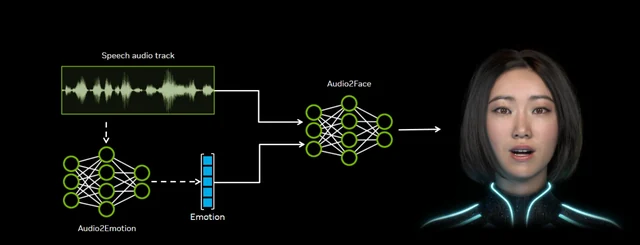 NVIDIA · source visual / reviewEmbodied systems4 min
How to connect speech synthesis, facial animation, expression direction, and rendering without letting a character’s face contradict the conversation.
Read guide ↗A governance loop for source ownership, effective dates, replacement, deletion, access changes, and answer verification.
Read guide ↗ Anthropic · source visual / reviewKnowledge & actions3 min
Treat retrieved text, attachments, web pages, and tool output as untrusted content before they can steer an action.
Read guide ↗Anthropic · source visual / reviewKnowledge & actions3 minUse Model Context Protocol tools without mistaking discovery metadata, tool descriptions, or a connected server for a blanket grant of trust.
Read guide ↗Razer · source visual / reviewEmbodied systems3 minDesign speech, text, timing, avatar motion, settings, and task completion as equivalent routes rather than a voice-only performance.
Read guide ↗Epic Games · source visual / reviewEmbodied systems3 minA study design for testing whether a body, face, voice, or spatial presence improves a specific outcome over a simpler interaction.
Read guide ↗NVIDIA · source visual / reviewConversation design3 minChoose turn boundaries by task and failure cost, then make barge-in, partial speech, tools, and cancellation obey the same state machine.
Read guide ↗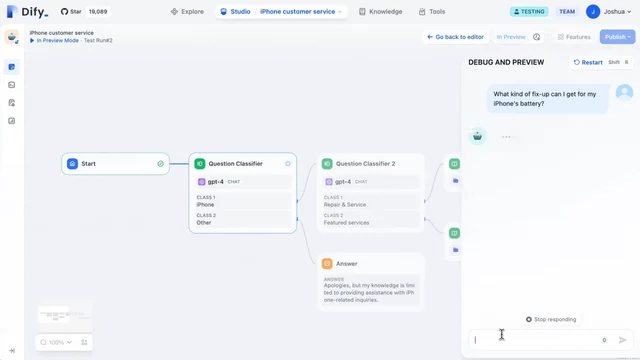 Dify · source visual / reviewConversation design3 min
A practical way to draw branches, state changes, retries, and exits so a canvas remains an operating model rather than a decorative diagram.
Read guide ↗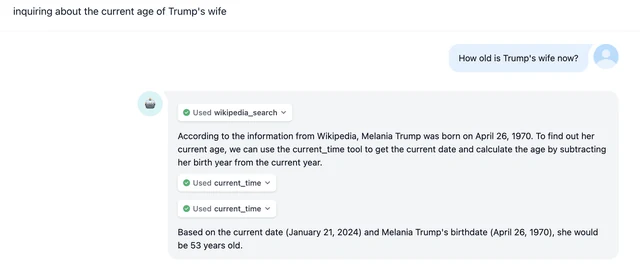 Dify · source visual / reviewKnowledge & actions3 min
A source-first investigation loop for finding whether a bad grounded answer came from ingestion, chunking, retrieval, context assembly, or response generation.
Read guide ↗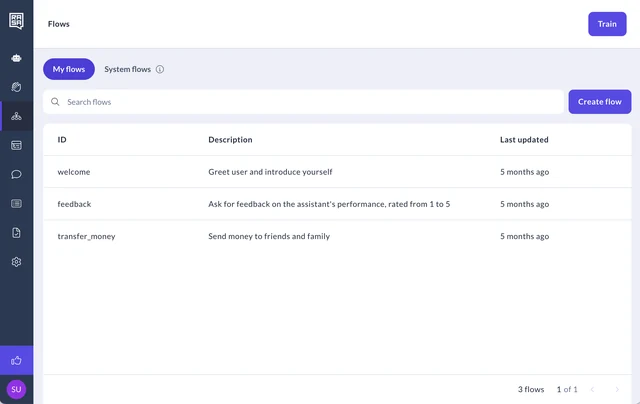 Rasa · source visual / reviewEvaluation & operations3 min
How to preserve the meaningful shape of a failed conversation, replay it safely, and assert behavior without pretending language systems are deterministic everywhere.
Read guide ↗Epic Games · source visual / reviewEmbodied systems3 minA device-aware budget for WebGL avatars that reserves capacity for input, audio, layout, recovery, and accessible fallbacks.
Read guide ↗Use typed output as a boundary between a model and a service, then apply the business checks that a well-formed object cannot know.
Read guide ↗Images, screenshots, and spatial interfaces need an explicit reference frame, freshness check, and confirmation path before a vague visual interpretation becomes an action.
Read guide ↗Give an embodied interface clear, interruptible states so its face, voice, and motion communicate actual service conditions instead of invented feeling or false progress.
Read guide ↗Treat an uploaded file as untrusted material with a controlled path from receipt to extraction, authorization, retrieval, and eventual removal.
Read guide ↗A long conversation needs explicit space for current intent, pinned constraints, verified evidence, and a fallible summary—not a mystery pile of old turns.
Read guide ↗Network loss is normal in voice. Restore intelligible conversation state without replaying speech, confirmations, or consequential actions that may already have happened.
Read guide ↗Give consequential conversational actions a durable identity so a network retry, duplicate tap, or reconnect can report one operation rather than create several.
Read guide ↗A practical contract for external work that outlasts one turn, with status language users can inspect and cancellation semantics engineers can keep honest.
Read guide ↗Keep isolation, revocation, and document scope at the retrieval boundary so a fluent answer never gets a chance to quote material the user cannot read.
Read guide ↗A citation is useful only when a reader can find the cited material, see that it supports the claim, and understand where the evidence stops.
Read guide ↗Publish what the service can do, where it stops, and the next route a person can actually use—then test refusals as carefully as answers.
Read guide ↗A useful feedback loop asks for the smallest context that can locate a defect, gives people a choice about follow-up, classifies the issue, and closes the loop without promising a fix.
Read guide ↗A human review rubric can make task correctness, evidence, action safety, and repair quality discussable—and calibration can expose where the policy itself is vague.
Read guide ↗A release package should say exactly what changed, what will be observed, who can stop it, and how to return to a known safe configuration without inventing a universal threshold.
Read guide ↗When a model, configuration, or system prompt changes, hold the other inputs steady, compare paired cases, and inspect the slices that can be harmed by an average improvement.
Read guide ↗Keep passwords, recovery codes, and one-time codes inside purpose-built authentication surfaces while the conversation explains the transition and preserves the task.
Read guide ↗A handoff should give the next person enough verified context to act, show the user who owns the case now, and stop the bot from competing for the same conversation.
Read guide ↗When two approved-looking sources disagree, route the contradiction to a named owner with evidence, a decision record, and a controlled propagation path.
Read guide ↗A transparent scenario worksheet turns contacts, automation completion, repeats, handoff time, and staff hours into assumptions a team can challenge—not a forecast or SLA claim.
Read guide ↗When automation may have changed the wrong thing, prioritize stopping further impact and verifying authoritative state before attempting any broad undo.
Read guide ↗A first run should reveal useful tasks, limits, and exits without turning a new user into a captive tutorial subject.
Read guide ↗A review screen is trustworthy only when changing a field invalidates the confirmations that depended on it.
Read guide ↗Incremental text can be useful, but it must not steal focus, flood announcements, or leave a broken transcript when someone stops it.
Read guide ↗A booking dialogue must distinguish what a person means in their locale from the time-zone-aware value a service needs to check.
Read guide ↗Dictated identifiers need an explicit readback and correction path; recognition confidence is not evidence that a number or name is right.
Read guide ↗A multilingual conversational system needs locale, direction, rendering, and review fixtures that make language-specific failures visible before release.
Read guide ↗A shared-device avatar must reset the visible display, media, local session state, and authority before another person begins.
Read guide ↗An avatar roleplay needs a defined objective, observable rubric, debrief, and transfer boundary—not a claim that simulated practice proves learning.
Read guide ↗An authored conversational character needs a reviewed canon, a visible world-state boundary, and a rule that session recall cannot rewrite the story.
Read guide ↗When motion, rendering, audio, or bandwidth fails, a conversational avatar should descend through explicit modes while preserving task state and accessible controls.
Read guide ↗A timestamped trace separates observed critical-path delay from an illustrative serial budget before a team tries to optimize a conversational wait.
Read guide ↗Treat streamed tool arguments as an incomplete transport representation until a terminal event, one call identity, and current-turn checks make execution safe.
Read guide ↗Authenticate and record a delivery once, then reconcile the business record that delivery describes instead of treating delivery mechanics as proof of state.
Read guide ↗Give each request a deadline, one retry owner, and a finite retry allowance so nested clients do not amplify a transient fault into a wider outage.
Read guide ↗Cache only values whose audience, authorization, version, and freshness rule are explicit. This field note supplies an inspectable artifact, counterexample, and release checks.
Read guide ↗Choose chunk boundaries with controlled evidence fixtures instead of assuming one size or overlap works for every corpus. This field note supplies an inspectable artifact, counterexample, and release checks.
Read guide ↗Release grounded answers only after testing questions that should remain unanswered, conflicted, or unsupported. This field note supplies an inspectable artifact, counterexample, and release checks.
Read guide ↗Create clearly fictional, nonidentifying fixtures while measuring what their construction fails to represent. This field note supplies an inspectable artifact, counterexample, and release checks.
Read guide ↗Keep shared-room speech, captions, actions, and permissions attributable to a room participant rather than an animated surface. This field note supplies an inspectable artifact, counterexample, and release checks.
Read guide ↗Preserve owned records, documented tool contracts, and asset rights so leaving a provider is a tested transition rather than an emergency assumption. This field note supplies an inspectable artifact, counterexample, and release checks.
Read guide ↗Try a broader term or reset the field filter.